
Kore.ai Review (2026): What It Does, What It Costs, and Who It Fits

Quick Summary
Kore.ai is a broad enterprise AI platform spanning customer service, employee productivity, and agent development. It supports voice and digital interactions, agent orchestration, and enterprise governance. That breadth makes it worth considering for complex programs—but smaller teams should evaluate implementation requirements, product-specific pricing, and who will own the workflows before choosing it.
Kore.ai Is Built for the Enterprise, and the Commitment Reflects It
Kore.ai is frequently evaluated by enterprises that want to automate customer and employee workflows across multiple channels, with control over models, knowledge, integrations, and governance. Its breadth is a key advantage when the organization needs more than a single customer-service agent.
This review covers what Kore.ai does, how it's priced, and where it falls short, so you can decide if it fits your team.
Why Trust Us?
At Callers, we build AI-driven CX automation for high-volume call and message operations. We’ve seen firsthand what it takes to make these systems work at scale. Einride saved over $65,000 a year on inbound handling, went live in three weeks, and holds a 99.8% connection rate. That experience spans millions of real customer conversations.
So this review comes from that vantage point: what actually holds up when a platform hits real volume?
What Is Kore.ai?
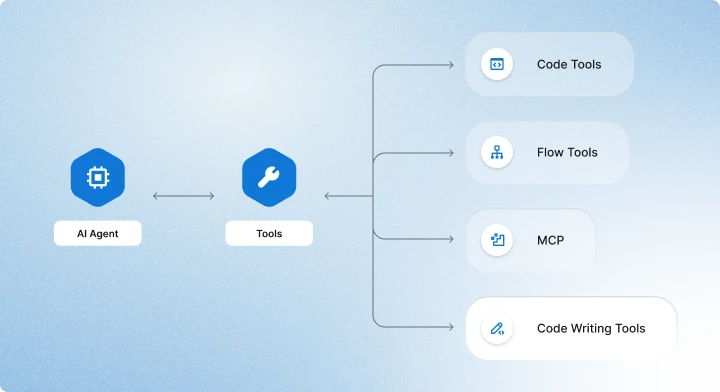
Kore.ai is an enterprise platform for building and deploying AI agents and virtual assistants. Its products span customer service, employee assistance, enterprise search, and multi-agent orchestration, with voice and digital-channel options.
For buyers, the practical question is which Kore.ai product and deployment model meet the requirement: AI for Service, enterprise agent development, AI for Work, and related capabilities are not interchangeable purchasing decisions.
Kore.ai has a strong enterprise orientation, especially where compliance, integration depth, and governance matter. Its industry-specific offerings are particularly relevant to banking, healthcare, telecom, and large service organizations.
Kore.ai calls itself an "agentic AI platform" for enterprises. It's designed for organizations that need multi-channel automation and deep integrations with CRMs, ERPs, and helpdesks. You can deploy on cloud, on-premise, or hybrid infrastructure.
Key Features of Kore.ai
XO Platform (Experience Optimization): This core product is a no-code/low-code and pro-code dialog builder with a multi-engine NLU. The NLU combines intent detection, contextual memory, and domain tuning. Business teams can build flows visually and developers can use JavaScript, API service nodes, and webhooks for custom logic.
GALE (Generative AI Layer for Enterprises): GALE is Kore.ai's framework for bringing large language models into the platform safely. It includes prompt management, model evaluation, retrieval-augmented generation (RAG) over enterprise knowledge bases, and governance controls.
AgentAssist: This real-time agent copilot surfaces relevant knowledge, scripts, and suggested actions during live conversations. It helps human agents resolve issues faster without toggling between multiple systems.
Industry-specific Solutions: Kore.ai provides pre-built vertical apps for businesses across banking, healthcare, IT support, and retail. Each vertical comes pre-configured with domain-specific intents and workflows.
Pricing
Kore.ai's enterprise pricing depends on the product, deployment, channel mix, usage, and service requirements. Its principal AI for Service sales experience uses a customized quotation rather than a universal public enterprise rate card.
From what's publicly known, the platform bills differently by product line:
Automation AI uses session-based billing in 15-minute increments
The Contact Center AI and Agent AI are billed per seat
Voice minutes, volume discounts, and add-ons like multilingual support and advanced analytics are negotiated separately
Professional services and custom training fees are additional and vary by implementation complexity
There's no self-serve tier.
Kore.ai has offered product-specific trials or developer access, but those options are not the same as an enterprise production contract. Confirm current trial availability and exact commercial terms directly with Kore.ai.
Industry Recognition

Kore.ai has been recognized in enterprise conversational AI analyst research and appears in software review directories. Rankings, review counts, and product categories change, so check the current analyst report and product profile when building a shortlist.
What We Like
Several Kore.ai strengths help it remain a strong contender on enterprises shortlists. Some of these strengths include:
Deep NLU and Dialog Engine: The multi-engine NLU combines intent detection, contextual memory, and domain tuning. This combination allows the platform to hold multi-turn conversations and switch topics without losing track. Query comprehension is one of the platform's clearest strengths.
Flexible Deployment Options: You can run Kore.ai on cloud, on-premise, or hybrid infrastructure. For regulated industries like banking and healthcare, on-premise keeps all data within your own environment. That's a hard requirement for organizations with strict data sovereignty rules.
Enterprise Compliance Coverage: The platform has SOC 2 Type II, HIPAA (with signed Business Associate Agreements), and GDPR-aligned infrastructure. Data's encrypted in transit (TLS) and at rest (AES-256). It also supports SSO integration with Google, Azure, and Okta.
Analyst Recognition: Kore.ai has an established enterprise profile and third-party analyst coverage. Buyers can review the latest assessments for the specific platform and use case they are procuring.
What We Don't Like
Kore.ai's broad platform creates trade-offs buyers should test in their own environment. These are the areas to probe before making a commitment:
Learning Curve: No-code tools help with basic flows, but complex agent orchestration, governance, and custom integrations can still require specialist configuration and training.
Integration Ownership: Validate the exact CRM, telephony, authentication, and legacy-system connections in a proof of concept. Confirm which integrations are packaged and where custom work is required.
Implementation Scope: Enterprise schedules vary with integrations, security approvals, deployment model, and internal resources. Ask for a phased rollout plan and acceptance criteria rather than relying on a generic deployment estimate.
Performance Validation: If low-latency voice and tool calling matter, test representative calls using your own integrations, concurrent loads, and escalation scenarios. No general latency benchmark should substitute for that test.
Who Kore.ai Isn't a Fit For
Kore.ai may be less suitable for a team seeking a narrowly scoped voice or CX deployment with minimal internal platform ownership. Its strength is breadth: that is valuable when enterprise governance and cross-functional AI projects are part of the brief.
If launch speed is critical, ask Kore.ai to demonstrate an initial production workflow and provide a committed implementation schedule for your specific integration and compliance requirements.
Evaluate who can edit and maintain agent flows after launch: business users, developers, the vendor's delivery team, or an integration partner. Operational ownership may matter as much as the agent features.
If transparent unit economics matter, request a quote showing usage assumptions, capacity, implementation, and support costs. Trial or developer offers may not match enterprise production pricing.
Kore.ai Alternatives
If Kore.ai's broader enterprise scope does not match your requirements, compare alternatives based on channel coverage, how customer context persists, implementation ownership, and actual total cost.
Platform | Typical Time to Live | Pricing Model | Channel Focus | Top Features |
|---|---|---|---|---|
Kore.ai | Project-dependent; request scoped schedule | Enterprise quote; trials or developer options vary | Voice, chat, SMS, email, 30+ channels | AgentAssist real-time agent copilot, multi-engine NLU with contextual memory |
Callers | Self-serve initial setup; Enterprise rollout depends on scope | Free; Starter $0.16/min; Enterprise custom | Voice + web chat (Free/Starter); voice, web chat, text + email (Enterprise) | Persistent customer context; self-serve initial setup; managed Enterprise option |
Cognigy (NiCE Cognigy) | Project-dependent | Custom quote, enterprise sales cycle | Voice, chat; deep CCaaS integrations | Built-in copilot for live agents, plugs directly into Genesys, Avaya, Amazon connect |
Poly AI | Managed implementation; timing varies | Custom quote | Voice-first | Built for phone-first, HIPAA, GDPR, PCI covered |
Decagon | Custom, sales-led | Per-conversation or per-resolution | Chat, email, voice | No code required, covers chat, email, and voice in one agent |
1. Callers
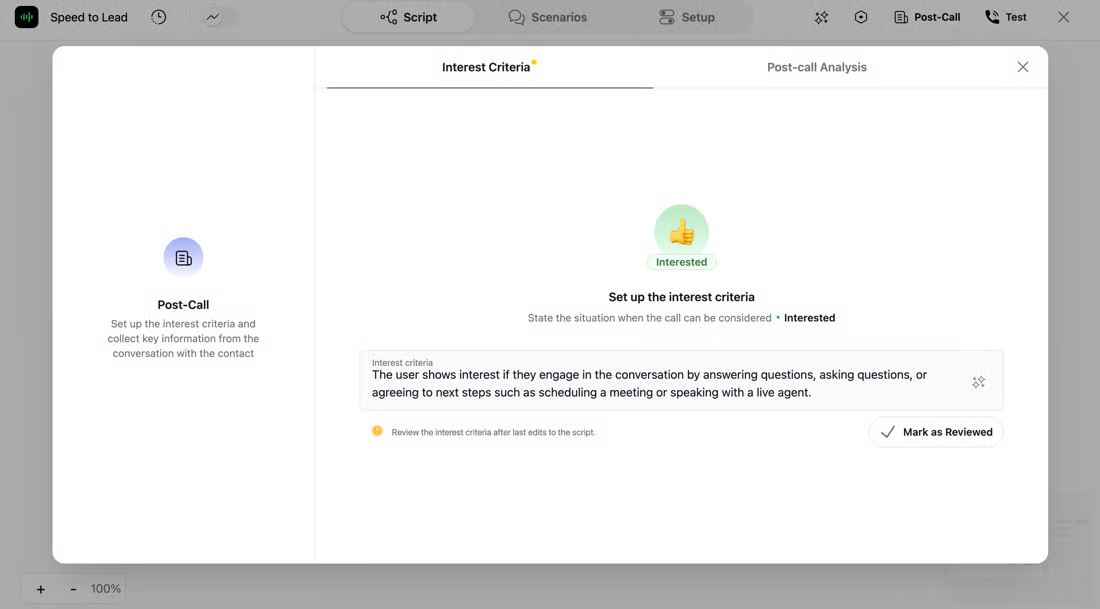
Callers.ai is built for high-volume B2C customer operations. Its AI agents handle inbound support and proactive outbound engagement, while persistent customer context can inform a customer's next interaction. Free and Starter include voice and web chat; Enterprise adds text and email for broader omnichannel workflows.
Operators can configure initial workflows through a self-serve builder, while Enterprise includes done-for-you implementation and a dedicated customer success manager. Starter and Enterprise provide access to 610+ native integrations; Enterprise also supports custom integrations and broader deployment controls.
Einride's public case study reports deployment in three weeks and more than $65,000 in annual savings. Voyager GM's case study reports 60% higher engagement, around 30% less agent workload, and a 90% reduction in time to lead. See https://www.callers.ai/case-studies/vgm-scaled-customer-support-and-sales/.
If your priority is a customer-facing agent that combines inbound support and outbound engagement with context carried forward, Callers belongs on the shortlist. Compare current plan limits at https://www.callers.ai/pricing/.
2. Cognigy
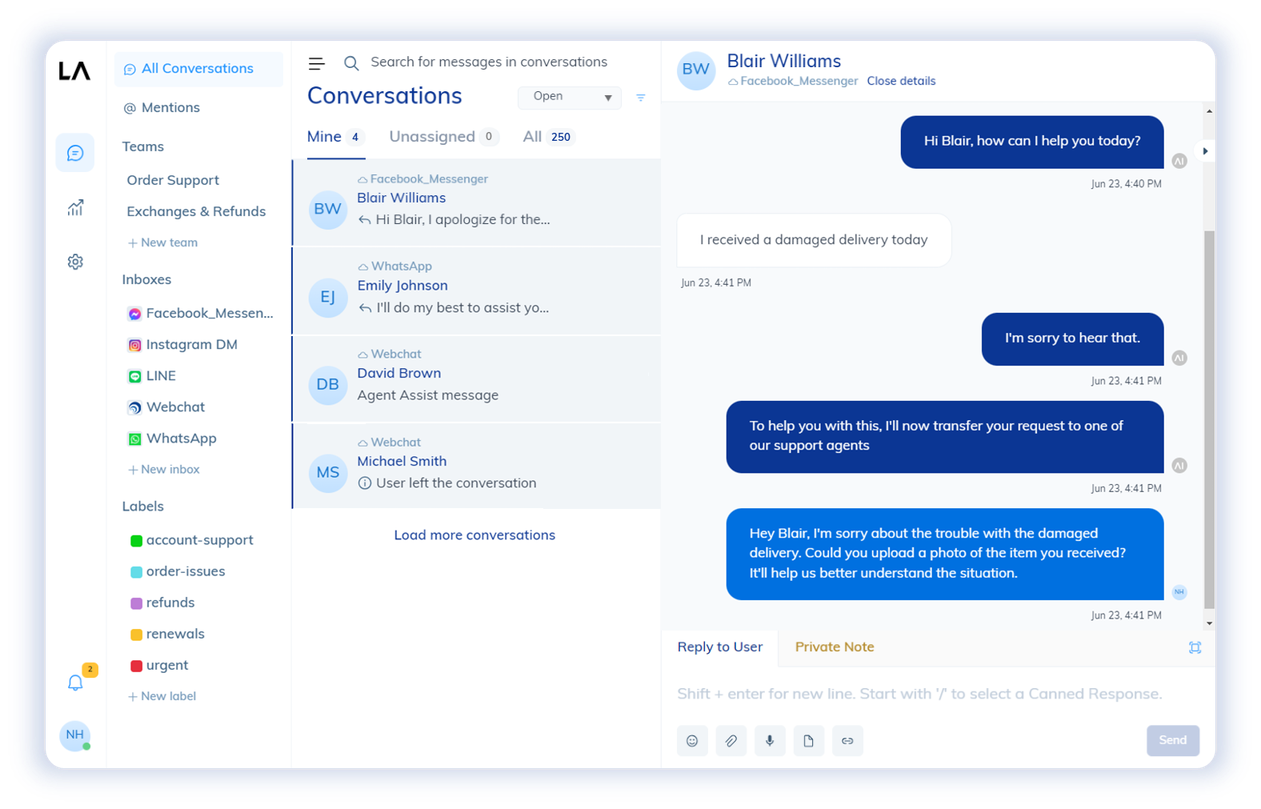
Cognigy (now called NiCE Cognigy) builds generative and agentic AI agents for voice and chat. If you're already running Genesys, Avaya, Amazon Connect, or NICE CXone, it plugs right in.
It's got similar depth to Kore.ai and it handles over a billion interactions a year with 99% routing accuracy. But you should expect a similar procurement timeline and sales process. If you want enterprise-grade without the enterprise wait, this isn't the tool for your team.
3. PolyAI
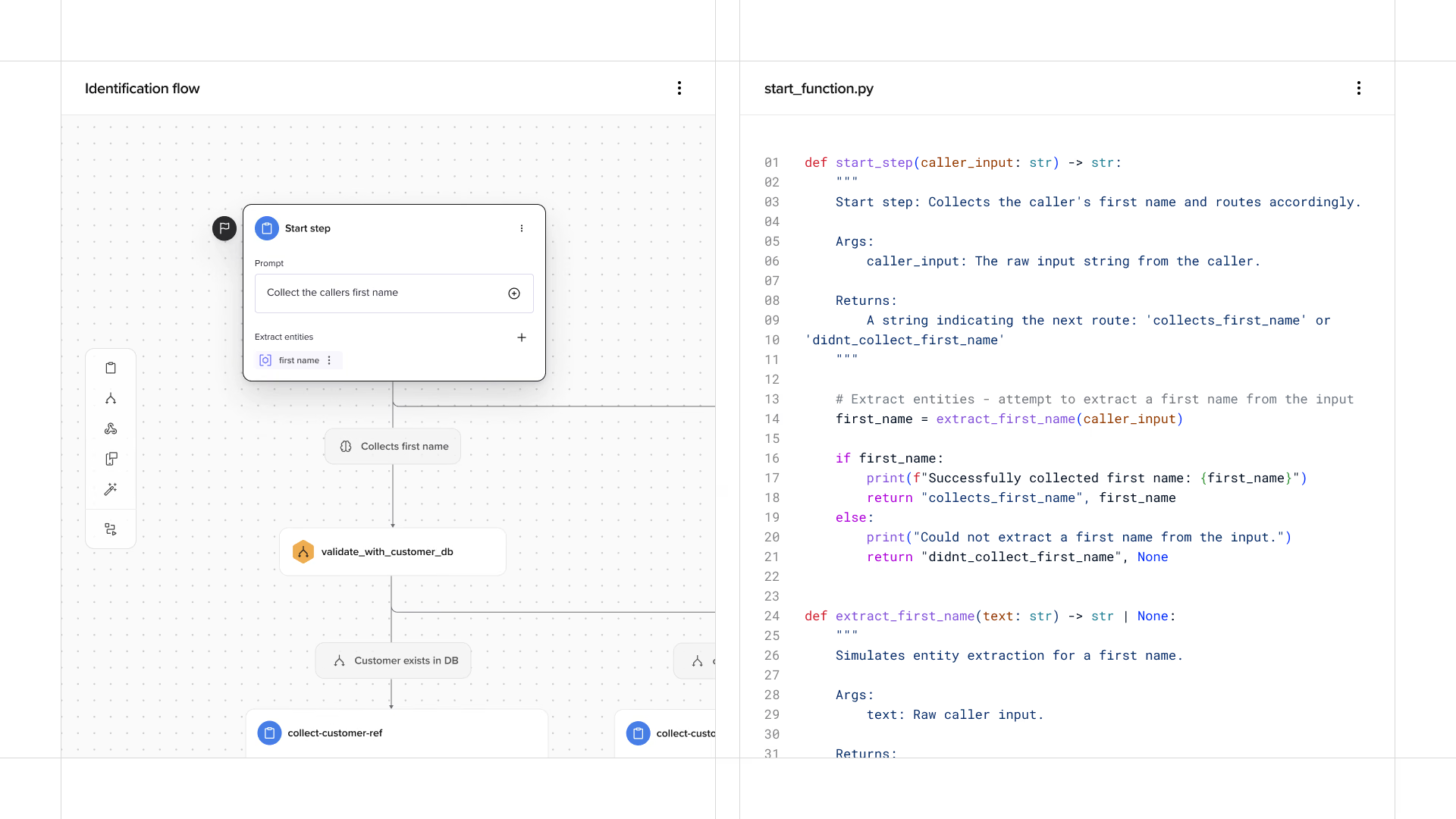
PolyAI is voice-first and is built around its proprietary Raven model that's been trained on over a billion enterprise conversations. If your primary need is phone automation and you don't need chat or email, it's purpose-built for exactly that.
The company offers custom pricing and ongoing use of the voice agent is priced on a per-minute basis. It also has SOC 2, HIPAA, GDPR, and PCI compliance. The trade-off is that it's voice-only, so there's no omnichannel you can tap into.
4. Decagon
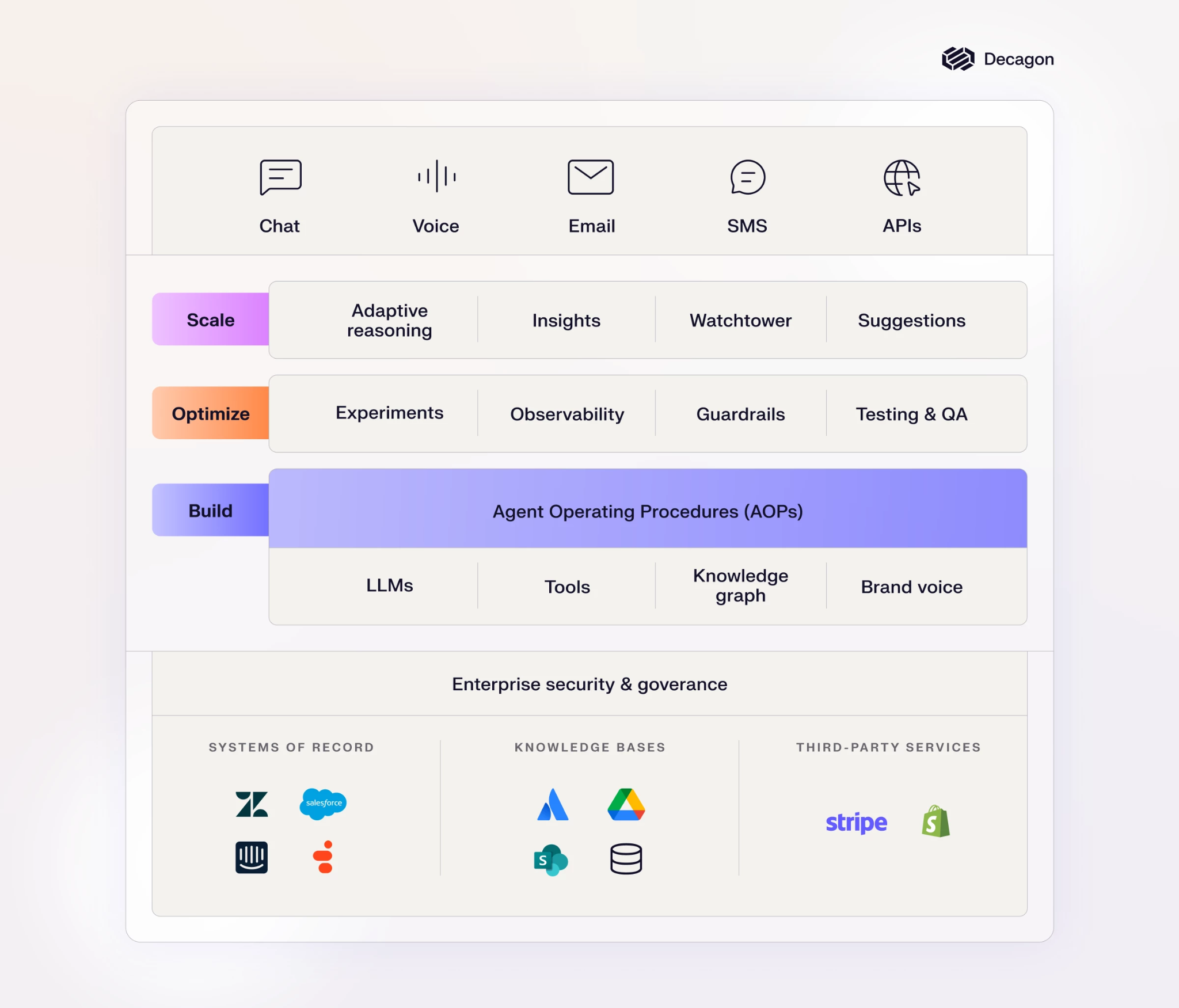
Decagon builds conversational AI agents for chat, email, and voice, and it works with big support teams like Chime, Duolingo, ClassPass, and Rippling.
Similar to Kore.ai, pricing isn't public and you'll need to go through sales. Decagon focuses more narrowly on customer support automation, so if your use case is broader than support, you may outgrow it.
For a broader comparison, see our guide on the best conversational AI platforms in 2026. And if you're evaluating Sierra, we've got a dedicated breakdown of Sierra AI alternatives.
Why Choose Callers?
Kore.ai makes sense when the remit includes employee AI, enterprise agent development, and centralized governance as well as customer service. Callers is more focused on customer-facing inbound resolution and proactive outbound B2C engagement. The decision is less about who has more features and more about what your team needs to operate.
1. Start Small, Then Scale the Right Workflows
Callers' published Free and Starter plans support self-serve setup for initial voice and web chat agents. Enterprise offers managed implementation for more complex, higher-volume omnichannel programs.
The no-code builder makes it possible for CX operators to iterate on workflows, subject to your own integration and approval needs. Start with a measurable inbound or outbound use case, then expand only when the outcomes justify it.
2. Keep Customer Operations Close to the Workflow
Both products provide tooling for building AI agents. Callers emphasizes customer-facing workflows that CX and growth teams can configure, with Enterprise services available for deeper integrations. Ask both vendors which post-launch changes your operators can make without engineering.
The important comparison is how fast each vendor lets your team diagnose, adjust, and measure an operational workflow after launch.
3. Choose the Support Level Your Team Needs
Enterprise buyers should compare implementation, training, and ongoing support in both proposals—not assume the same services or staffing are included by default.
Callers Free and Starter provide self-serve setup and 24/7 in-platform AI support. Enterprise includes dedicated customer success support and done-for-you implementation; its text/email channels and advanced enterprise controls are also plan-specific.
That gives buyers a straightforward choice between testing an initial workflow themselves and scoping a managed Enterprise deployment.
There Are Faster Ways to Get Conversational AI Live
Kore.ai is a serious enterprise platform with broad agent-development, service-automation, and governance capabilities. It deserves evaluation when those requirements are central to the purchase.
But any enterprise AI platform should be assessed against the specific rollout. Check integration responsibility, iteration speed, which features belong to which product, and the full quote before you commit.
For high-volume B2C teams prioritizing support resolution, proactive outbound engagement, and customer continuity, explore Callers' AI call center workflows at https://www.callers.ai/use-cases/ai-call-center/. Review plans at https://www.callers.ai/pricing/ or book an Enterprise discussion at https://www.callers.ai/book-a-meeting/.
Frequently Asked Questions
1. Does Kore.ai Offer a Free Trial?
Kore.ai has offered time-limited trials or developer access for some products. Trial eligibility, duration, and product scope can change, so confirm current availability with Kore.ai. An enterprise evaluation should also test your actual workflow, integrations, and support requirements.
2. How Long Does It Take to Implement Kore.ai?
There is no meaningful universal deployment timeline. A focused proof of concept can differ sharply from a regulated, multichannel rollout with legacy integrations. Ask Kore.ai for a phased schedule tied to your use case; Callers likewise offers self-serve initial setup and scoped Enterprise implementation.
3. Is Kore.ai HIPAA Compliant?
Kore.ai offers enterprise security and deployment options, including on-premises or customer-controlled environments for certain configurations. Confirm the exact HIPAA/BAA, SOC 2, regional data handling, and contractual terms for the product and hosting model you would buy.
4. What Industries Does Kore.ai Serve?
Kore.ai has the strongest presence in banking, healthcare, telecom, and retail. It offers pre-built vertical solutions (BankAssist, HealthAssist, RetailAssist) with domain-specific intents and workflows. Companies like Cigna, PNC, AT&T, and Florida Blue use the platform.
5. What Channels Does Kore.ai Support?
Kore.ai supports 30+ channels, including voice, chat, SMS, email, WhatsApp, Slack, Microsoft Teams, and social messaging. That channel breadth is one of its strengths, because you can put one virtual assistant on every channel your customers use.